
- What is an electronic invoice?
- What is meant by "facturation electronic" in France?
- What is the purpose of the reform and how will it work?
- Is everyone concerned by the reform?
- In which cases issuing an electronic invoice will be obligatory?
- Which operations are not concerned?
- What are the deadlines?
- Will one have to pay? Which platform to choose?
- Most common questions and answers:
- Need more information?
The electronic invoicing obligations are soon coming into force in France, and a lot of rumours and misinformation is spread, making small business owners panic. The article aims to provide some simple and clear information on the topic.
What is an electronic invoice? #
This is a new standard of issuing invoices where data is stored in a special file format readable by various software, rather than a text from (it should also still be available to view as text for end users). It is not the same as issuing a pdf invoice. One of the most populat formats is called Factur-X. Electronic invoices are used in many EU countries, and many invoicing apps can issue an e-invoice
What is meant by “facturation electronic” in France? #
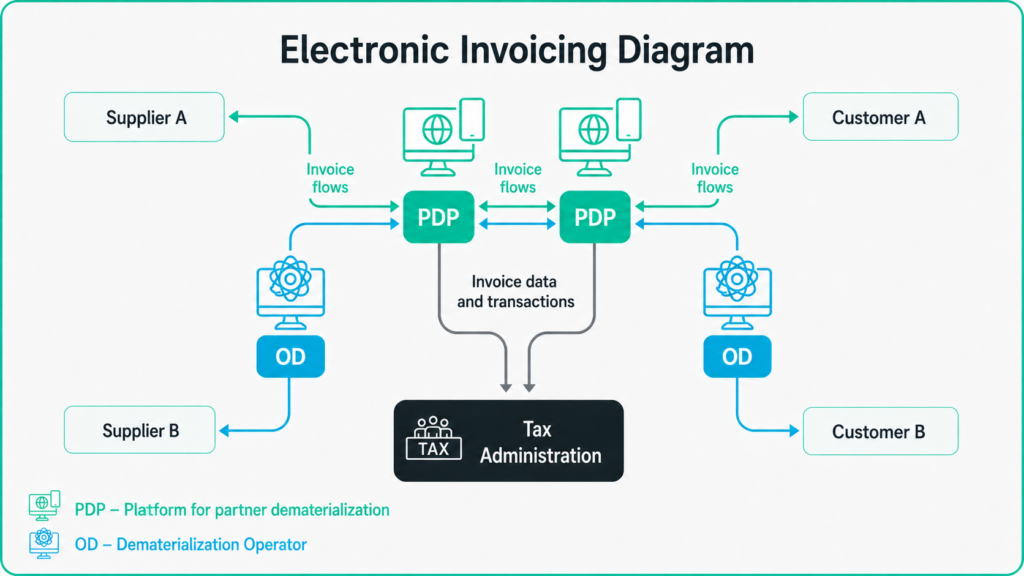
The French reform means not only issuing invoices in electronic format, but also dong so using an approved system, that would send the invoice via a special France-only data exchange network that connects French businesses and the tax administration.
What is the purpose of the reform and how will it work? #
The purpose to to fight VAT fraud, especially on B2B transactions.
Issuing electronic invoices using the French gouvernement data exchange system will only be obligatory for operations between businesses in France.
Each French business that falls under reform, regardless of whether they actually buy something from French suppliers or not, will have to designate a platform to receive e-invoices – like a special inbox – where all invoices arrive, can be viewed, accepted or declined (in case of disagreement or error) and paid. One can use several platforms/services to issue electronic invoices, but only one to receive them.
When an invoice is issued by a supplier, it is sent to the client and at the same time to the tax office. Each time a client changes the status, (accepted/declined/paid), the information is transmitted to the supplier and the tax office. This way the VAT tax declaration will be prefilled with the relevant information.
Is everyone concerned by the reform? #
Almost every business with a SIRET number is concerned by the reform, including micro (auto) entrepreneurs that are not VAT registered (franchise en base de TVA).
The main exception is businesses whose activity would never fall under VAT at all, even past the threshold — medical and paramedical professions (like osteopaths), some real estate rental activities etc – these organisations will only have to register to receive electronic invoices, but will not have to issue electronic invoices or submit e-reporting
Non-profit associations that do not carry out activities for profit and non-profit associations carrying out only anxillary commercial activities (its management is disinterested, its commercial activities do not compete with the private sector, and those profit-making activities represent only a marginal part of the association’s budget and remain below €80,011)ot affected by the reform: it is not required to issue electronic invoices or transmit transaction and payment data. It is also not required to be able to receive electronic invoices from 1 September 2026.
In which cases issuing an electronic invoice will be obligatory? #
For B2B transactions in France. If your business is registered in France, not currently declaring VAT (franchise en base de TVA) and is selling goods or services to VAT registered French businesses, you will have to use the e-invoice as well.
Which operations are not concerned? #
- invoicing clients outside of France
- invoicing/selling to private customers in France
Business owners will have to report these transactions using an e-reporting tool (details on how this will work are upcoming), but do not have to issue e-invoices as such. This will probably look closer to existing VAT declarations, or URSSAF declarations for micro entrepreneurs.
If you work with both categories of clients, you will have to issue electronic invoices only to French B2B partners.
What are the deadlines? #
- Selecting your provider to receive e-invoices from your French suppliers – September 1, 2026.
- Issuing e-invoices/e-reports for large companies (over 250 employees or 50M € annual turnover) – September 1, 2026
- Issuing e-invoices for all other businesses and doing e-reporting – September 1, 2027.
Will one have to pay? Which platform to choose? #
A lot of service providers use the hype to promote their proposals. Take you time to study your options and choose the most suitable solution. Remember, you can use on3 platform to receive and another one to issue your invoices. What to keep in mind:
- Many providers have free starter versions – such as Abby, Indy, Dougs, Henrri. They may have limited functionality or be less user friendly, but you will be able to continue doing business without any added cost.
- If you have an accountant, it will be easier both for you and them if your solution integrates well with their software
Most common questions and answers: #
-Was this to prevent false invoices?
Yes, in large part, to combat VAT fraud in all it’s forms. I theory, should make accounting and VAT declarations easier as well, especially for people who struggle to collect all of their purchase invoices.
– So AEs (independents) that work only with individuals (not businesses) are not concerned. Correct?
– What if all of your clients are outside of the EU? Do you still need to register?
You still have to register to receive e-invoices by the 1st of September 2026, and will be concerned by e-reporting from the 1st of September 2027.
– I am a Relocation consultant to Americans. Do I have to do this invoicing? No french clients.
– My business is NOT with a french business or people so I do not have to do the electronic invoicing and I can continue to use my PayPal invoicing system to send to clients?
– All my clients are native English speakers, how to produce an invoice that is suitable for English speaking clients and satisfy the French authorities?
Unless your clients are French businesses, you will be able to use any form of invoicing that suits you event after September 2027, but you will have to work out an efficient system to collect data for e-reporting. You must register to receive e-invoices by this September.
– What about invoices to foreign clients who need me to use their own invoicing platform?
Not a problem, does not fall under e-invoicing regulations, so you can still use their platform. You will have to collect data for e-reporting, and file the reports.
– Is there a guarantee that the free platforms will always be free?
I think you need to read carefully the conditions of each platform… You can also always switch a platform if the one you’re using is no longe free.
– As a service provider, I don’t buy anything. The only things I buy are “débours” for my clients. Those should also be invoiced through the platform (when the invoice is not to my name but the client name?)
Débours do not fall under the e-invoicing reform, you will have to create a separate “note de débours” outside of the e-invoicing platform.
– If you have an accountant and running a BnB surely the accountant will report the income, or do you need to ereport to the accountant or are these separate reports?
If your BnB is subject (or can be subject) to VAT, your business needs to choose a platform for receiving e-invoices. It best to select the one that integrates will with your accountant’s system, normally they should have proposed one to you by now. But it is your responsibility as business owner, not your accountant’s, to make sure you’re registered. If your business is outside the scope of VAT, you’re not concerned by the reform.
– Qonto are offering this as part of their package. But would you suggest long term it’s better to NOT have your invoicing as part of your banking solution.
If you have a separate accounting system, it’s best to use a solution that integrates well with that. Many banks now offer a their solution, but most of them are not very convenient. Qonto is an exception, I think their invoicing tool is great. So if you’re not worried about accounting, I’d use Qonto if your account is with them.
– How does one enforce French businesses to share their electronic invoices for us to receive them on our selected platforms when they can’t even figure out how to process a payment online and send cheques instead?
This normally should not be your burden, but the one for the tax office. Your only point of pressure as a business owner is payment. You simply do not pay unless you receive an electronic invoice. You should fully understand that if you don’t have an eletronic invoice for a purchase (from September 2027), this expense will have to be accounted for as your personal expense, and not a business expense. Potentially you can also complain to the tax office, who will be fining businesses for not issuing electronic invoices (per invoice issued).
Need more information? #
You can watch replays of webinars I did on this topic, there were sessions in Russian and in English.
The tax website has a nice tool that will ask you a few questions about your business, and will provide you with personalised information.
https://entreprendre.service-public.gouv.fr/vosdroits/R74135 – official registry of companies who’ve signed up for a platform
https://www.impots.gouv.fr/je-consulte-la-liste-des-plateformes-agreees – list of approved platforms


